Why bother with 125 kHz?
The cheap Tesla-style BLE TPMS sensors I run on the 135i (and decode in TrackDayPyrometerHelper and TPMS Monitor) are great once they are awake — pressure, temperature, and battery over 401 MHz BLE. The problem is getting them to wake up on demand.
Motion and a few PSI of pressure change will eventually wake a sleeping sensor, but that is slow and unreliable when you want a reading in the paddock when your trying to get hot tire temps. Factory tools like the ATEQ VT30 (what Tesla service uses for Continental sensors) fire a 125 kHz low-frequency burst at the valve stem. The sensor hears it, wakes, and starts broadcasting.
I wanted that same trick on my handheld PyroTC pyrometer — tap a button, wake the nearest sensor, passivly read the pressure from my pyrometer android app, then store when I have all tire temps done. That meant reverse-engineering the LF telegram and building a coil driver small enough to fit inside the enclosure I already designed.
Capturing the wake telegram
The starting point was an Autel TPMS tool scope capture — the same kind of 125 kHz burst an EL-50448-style relearn wand sends, I used a 2008 bmw continental signal which happens to work on the tesla sensors. I ran the raw scope trace through decode_scope_to_replay.py to pull out the bit timings.
The result is a fixed OOK replay table: 184 uniform half-bit slots at 128 µs each (~23.6 ms total telegram). Each slot is either on or off — no variable Manchester edges. The table lives in auto-generated cont_wake_data.h; regenerate upstream and re-copy lf_wake.h, lf_wake.cpp, and cont_wake_data.h if the capture changes. Do not hand-edit the data header.
What 125 kHz looks like on the bench
On a Hantek DSO2C10 at 20 µs/div and 500 mV/div, the carrier is a clean 125 kHz sine burst — about 2.5 cycles per division. Amplitude peaks around 2 Vpp at the coil, gated on and off by the OOK envelope.
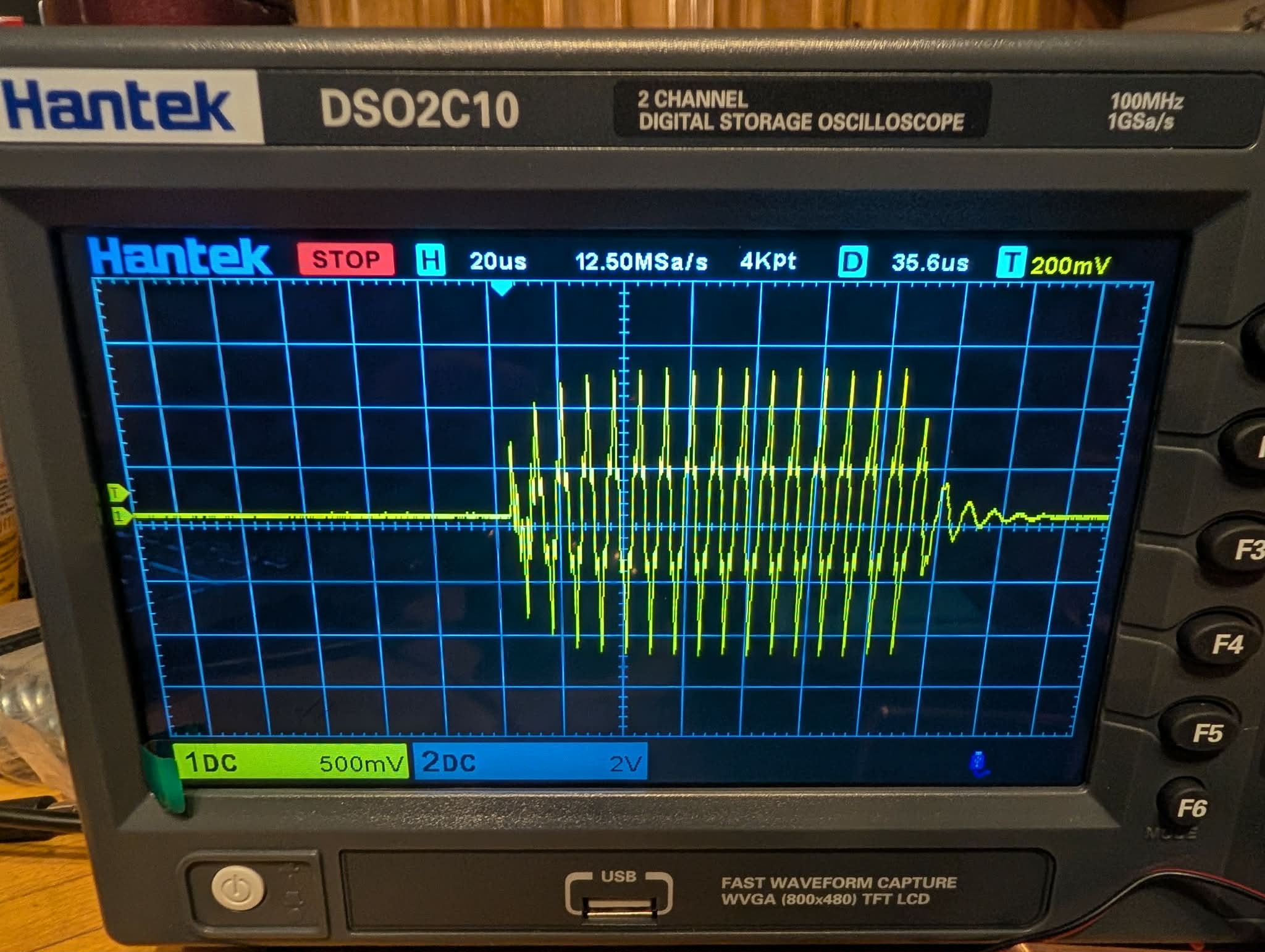 ~160 µs burst envelope on a 125 kHz carrier — this is what the replay table modulates.
The scope shot is the sanity check that the decoded timings actually produce the right carrier frequency before you point it at a tire.
LF coil driver hardware
The ESP32 cannot drive a 125 kHz tank coil directly, so the driver is a separate 9 V domain (only GND shared with the MCU):
| Part | Role |
|---|---|
| EL-50448 coil (or equivalent 125 kHz antenna) | Magnetic coupling to the valve-stem sensor |
| 10 nF tank capacitor | Parallel resonance with the coil |
| IRLZ44N logic-level MOSFET | Low-side switch — GPIO → 100 Ω → gate |
| 9 V supply | Enough headroom for the burst; isolated from the 3.3 V ESP32 rail |
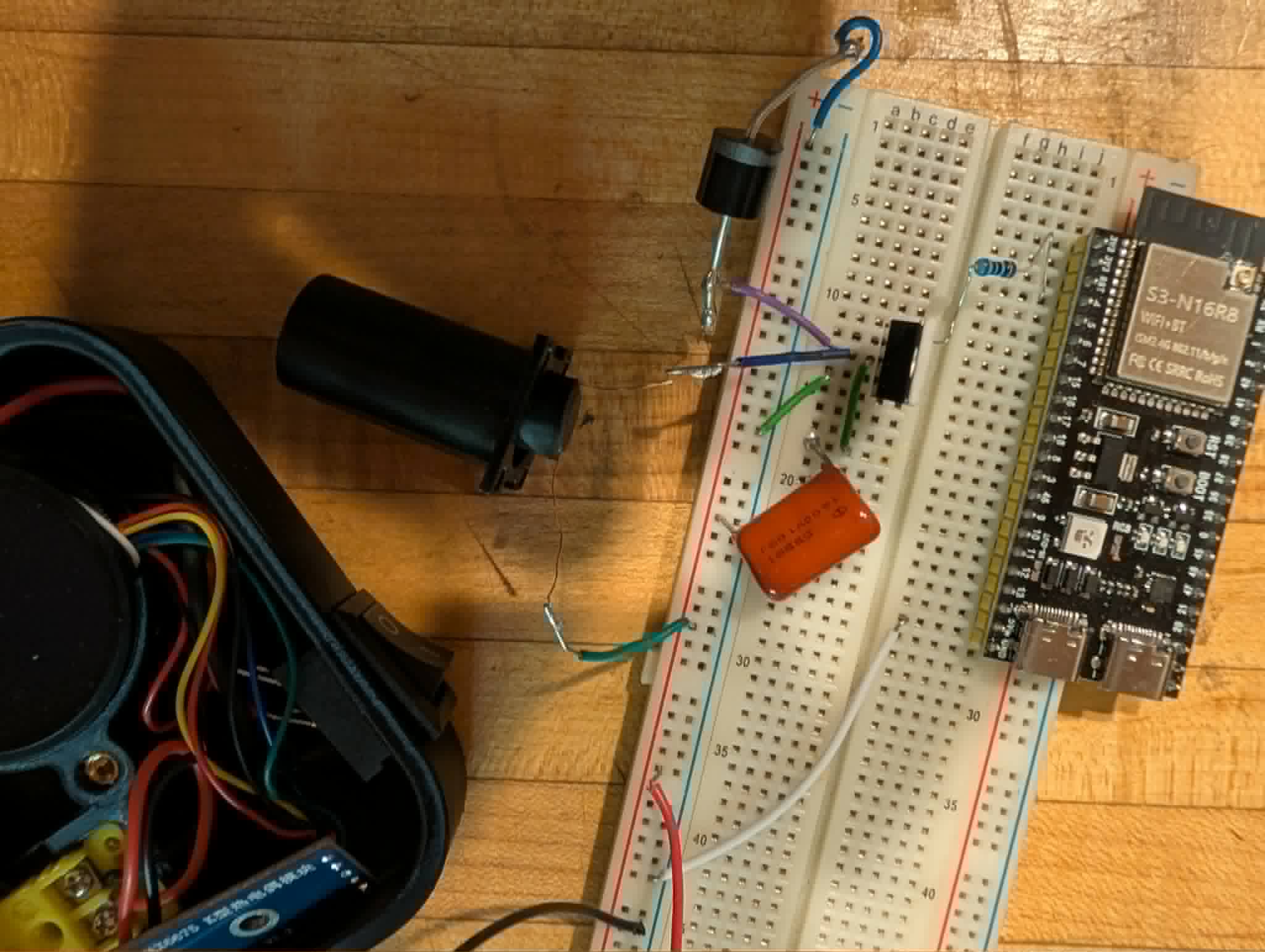 Breadboard bring-up — ESP32-S3 dev board, EL-50448 coil, tank cap and MOSFET driver; pyrometer enclosure shell on the left for fit check.
GPIO4 (LF_COIL_PIN, set in platformio.ini build flags) drives the MOSFET through LEDC PWM at the bit-slot rate. The buzzer stays on plain digitalWrite — no pin clash.
Firmware on PyroTC
The LF wake driver is built into PyroTC (lf_wake.h, lf_wake.cpp, cont_wake_data.h). On the RECORD screen a cyan WAKE button sits centre of the bottom rim between CLEAR and BACK. Tap it and the gun fires a 10 second burst (startWakeBurst) — sensors mostly work with 5sec but some were stubborn.
Timing is exclusive: while wakeActive, loop() runs only serviceLfWake() and returns early. No MAX6675 read, no LCD repaint, no BLE — a thermocouple conversion takes ~220 ms and would jitter the 128 µs bit grid. The gap loop calls delay(1) to keep the task watchdog fed. The burst auto-ends after 10 s; there is no mid-burst cancel.
The wake path is one-way — no new BLE characteristics. The existing PRESS/SENS/MAP slots (…0004 / …0005 / …0006) stay free. Pressure still comes back through the phone app scanning BLE after the sensor wakes.
// LF_COIL_PIN = 4  (platformio.ini build_flags)
// 184 × 128 µs OOK slots from cont_wake_data.h
// WAKE button → startWakeBurst() → 10 s exclusive serviceLfWake()
Full build and flash on your machine:
pio run -t upload
pio device monitor -b 115200
Fitting it all in the housing
The pyrometer enclosure was already tight — round Waveshare head, 18650 grip, MAX6675 breakout, rocker switch. Adding a 125 kHz coil, a 9 V boost module (XL6009E1 step-up), and the MOSFET driver meant revisiting the Fusion 360 assembly. Someday i will learn to put all the filet’s at the end, so many broken filets when I stretched the initial body sketch…
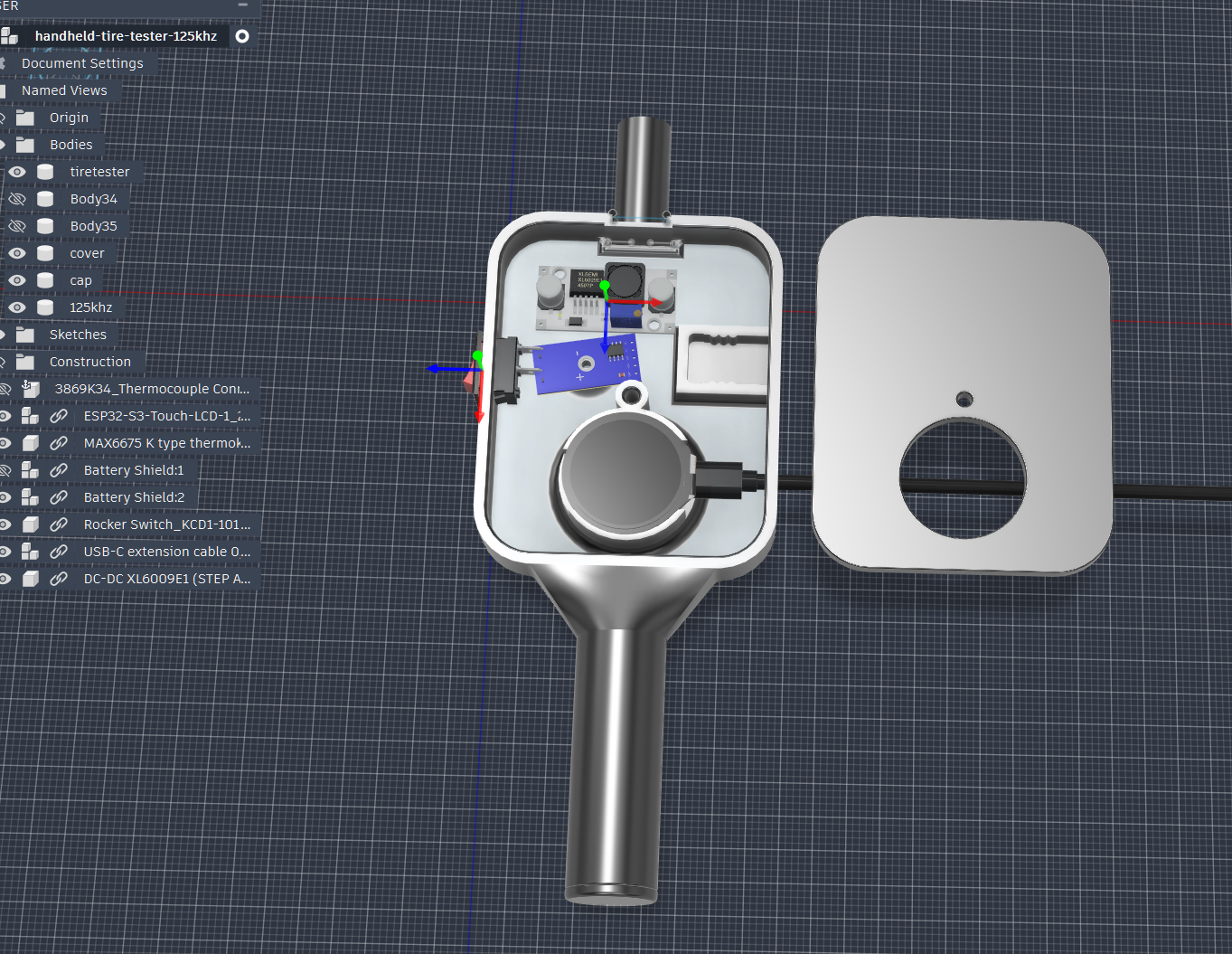
handheld-tire-tester-125khz — ESP32-S3 round LCD up top, coil and DC-DC in the head, battery shields on the right, USB-C extension on the side.
The coil sits forward in the head so you can hold the gun near the valve stem like a factory relearn tool. The XL6009E1 boost board feeds the 9 V tank; the ESP32 and MAX6675 stay on the existing Li-ion rail. Everything still has to clear the round faceplate cutout and the screw-on battery cap at the bottom of the grip.
Original STLs for the pre-LF enclosure are in /cad/pyrotc/ (tiretester.stl, cover.stl, cap.stl). The 125 kHz revision is still in CAD — print-test-fit cycle next.
What is next
- Print the revised head and confirm coil placement wakes a sleeping Continental sensor on the first tap.
- Decide whether the 10 s burst duration is right for paddock use or if a shorter pulse train is enough.
- If TPMS data ever flows back through PyroTC over BLE, that needs new GATT characteristics coordinated with
PyroSync.ktin the Android app — same rule as the temperature contract.
For now, the hard part is done: I have the signal decoded, the replay firmware, and a housing layout that might actually close. The rest is mechanical patience.