I wanted a lighter arm for my Samsung tablet in its RAM case. Could the ribs around a single clamp bolt do the job? We opened up a 62 mm double-socket arm, then pulled on its outer cup in a simulated bend test. The first crack and the final break happened at opposite ends.
Getting the 150 mm arm to pivot 90°
The first 150 mm spiderweb arm clamped onto the ball, but when I swung the arm sideways on the mount, the stem hit the socket rim before the tablet reached the angle I wanted. I relieved the rim on both jaws at both ends. The stem can now swing out through the split on either side in the CAD assembly.
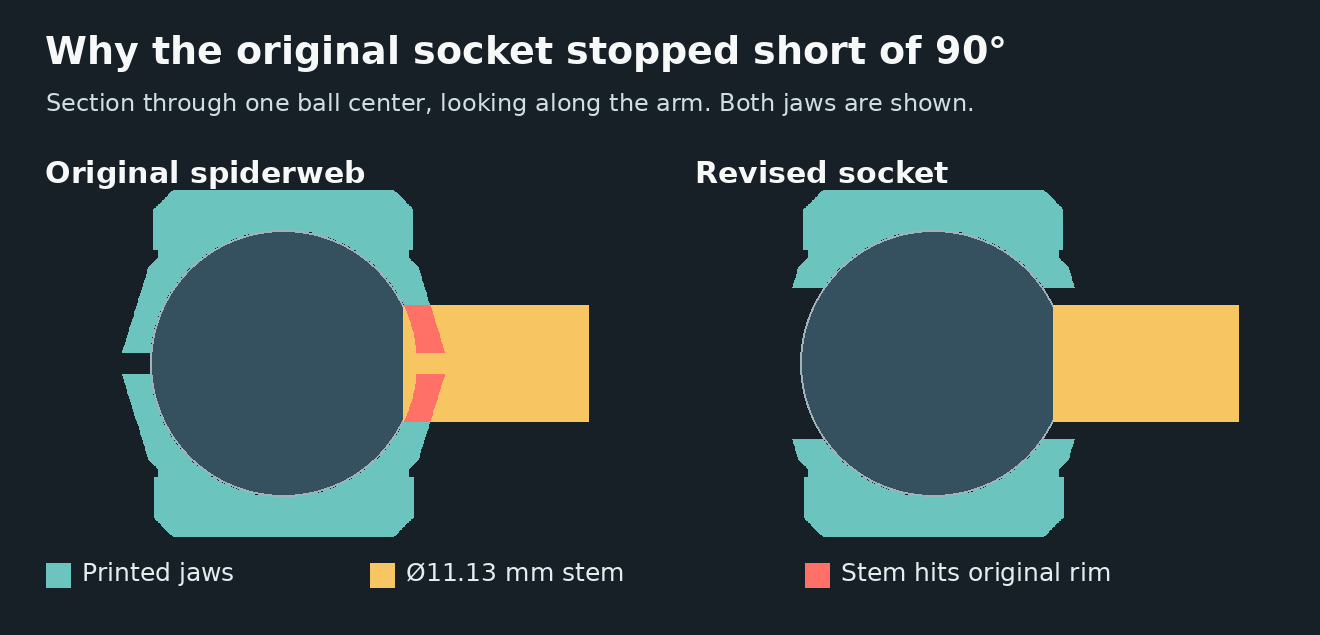
The 1 inch measurement is the ball diameter. RAM’s aluminum diamond base has a 0.438 inch (11.13 mm) stem. I swept that diameter and a larger 12 mm stem from straight out to 90° at both ends. Both cleared through the full swing with the jaws 2 mm apart and again with the split narrowed to 1 mm. RAM-B-238U dimensioned drawing
For the 90° version, print two identical 150 mm jaws with the flat washer face on the bed and the cups up. Reuse the spiderweb arm’s M6 × 40 mm hex-head bolt, plain M6 nut, 18 mm washer and knob. The ZIP includes the revised jaw STL, editable SolidCraft model, original knob STL and print instructions. Download the 150 mm spiderweb 90° print pack
Did opening the sockets weaken the 150 mm jaw?
I ran the original and revised jaws through the same simulated bend test. I held the left cup fixed and applied a downward load 50 mm beyond the right ball. Watch the rib beside the fixed cup. It was the first place to show damage in both jaws.
On the finer mesh shown in the video, first damage occurred at 60.68 N on the original jaw and 60.34 N on the revised jaw, about 0.6% earlier. The revised jaw carried a higher peak on this mesh (64.42 versus 61.22 N), but the coarser mesh put both peaks within 0.04 N of each other. Across the two runs, opening the sockets showed no consistent loss in peak bending strength. Download the 12-second comparison (MP4)
Grip is the remaining bench test. The relief removed 27% of the spherical seat area from each cup. The simulation held the base cup fixed, so it leaves open how much torque the printed assembly can hold at 90° before the ball slips.
Choose a thumb knob
The original knob has a scalloped rim. For the lighter version, I split the grip into three curved fingers around the same M6 nut pocket. Both fit the arm and use the same plain M6 hex nut and 18 mm washer. If you already printed the jaws, the knob is the only part you need to print.
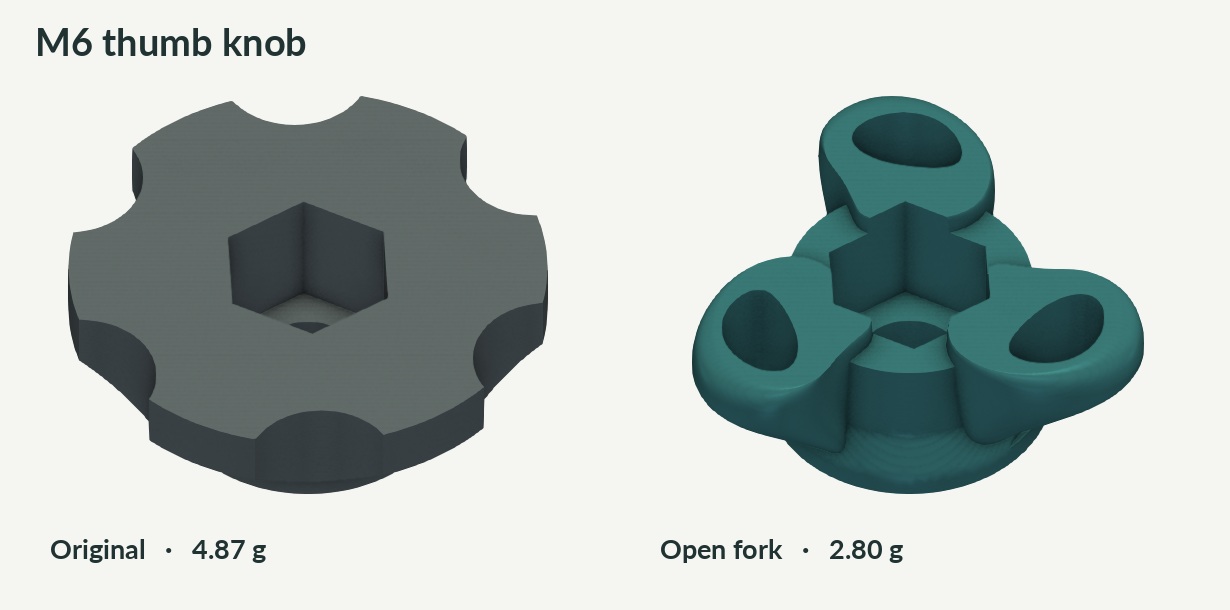
| Knob | PAHT-CF per print | Predicted twist under a single finger at 1 N·m | Print file |
|---|---|---|---|
| Original scalloped grip | 4.87 g | 0.06° | Download original knob STL |
| Open three-finger grip | 2.80 g | 0.22° | Download three-finger knob STL |
The open knob saves 2.07 g per print (42.5%) in the same slice. The original is stiffer in the twist simulation. I also tried wider openings. They saved another 0.24 g, but one finger flexed about 73% more on the same mesh, so I kept the thicker roots. The printed knob still needs a hand-tightening test.
The video shows the wider-window trial first and the selected knob second, with movement enlarged 28×. Print either knob washer face down, hex pocket up. I used a 0.4 mm nozzle, 0.20 mm layers, five walls and 40% gyroid. The open fingers reach 0.61 mm farther from the screw axis, so check clearance through a full turn.
Starting from scratch? The 62 mm open-fork pack includes the reinforced jaw, the three-finger knob, editable SolidCraft files and both print guides. Print the jaw twice and the knob once. Download the 62 mm open-fork arm and knob ZIP
From spiderweb to organic wrap
The spiderweb put most of its openings between the two balls. For the next version I wanted the ribs to wrap around each 1-inch ball as well. Look at the black ball through the opening on the left. The curved fingers touch it on spherical pads. On the 62 mm jaw those pads retain about 74% of the contact area of the original solid cup. The new jaw is 46.5 mm wide across its broadest point, up from 42.9 mm on the spiderweb.
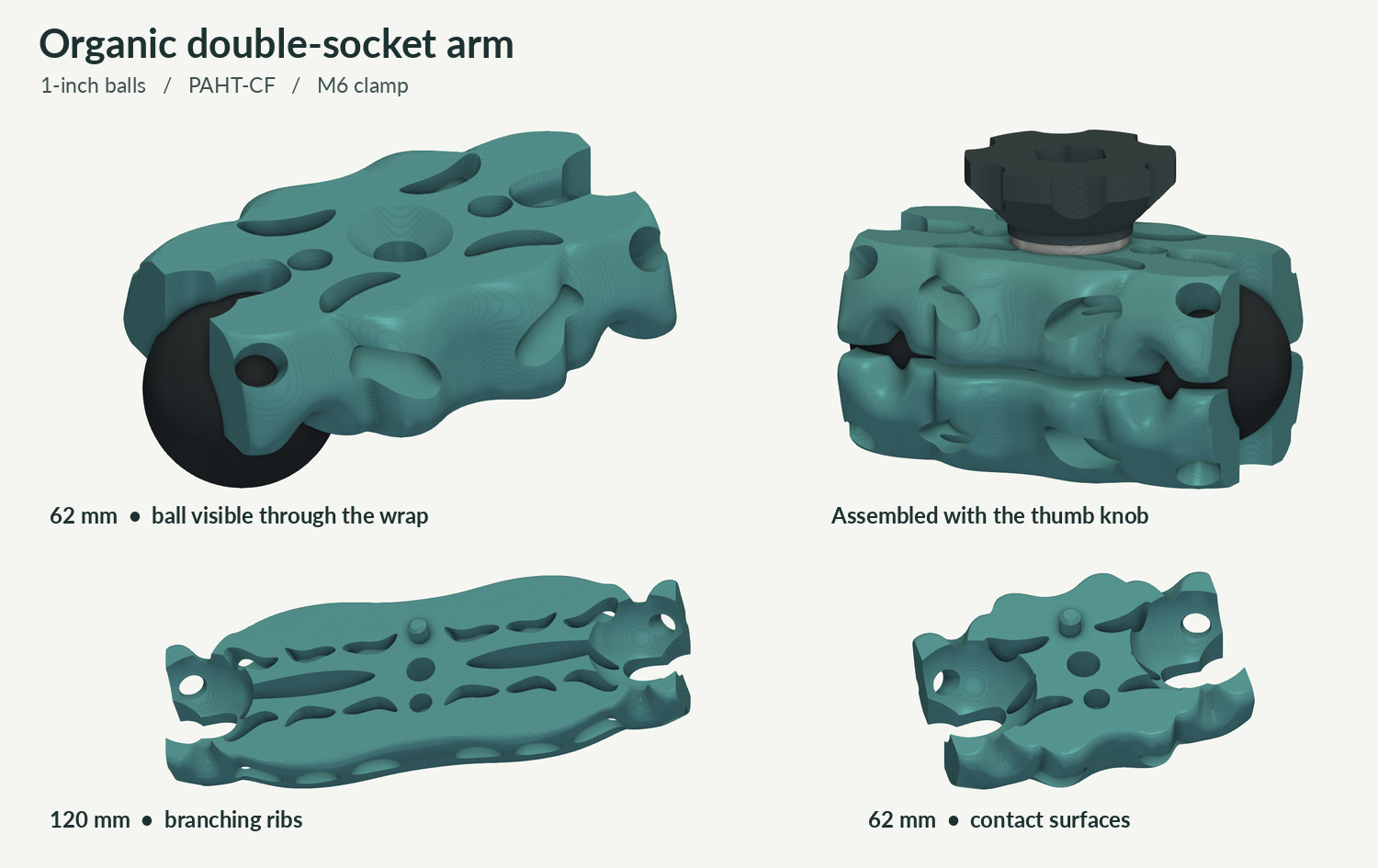
Where the extra material went
The first open jaw flexed at the shoulders where the sockets meet the arm. Widening those shoulders helped. Then a thinner version passed both whole-jaw bending tests, yet one finger still spread too far when loaded on its own. The stress map pointed to a small arc at its root. Thickening that arc brought its movement under the limit while using 0.70 g less filament per jaw than thickening the roots all around.
| Time | What to watch in the 62 mm test |
|---|---|
| 0:00 | The first jaw bends 0.448 mm vertically. The limit was 0.230 mm. |
| 0:08 | The thinner wrap passes whole-jaw bending, but one socket rib moves 0.061 mm under 20 N. Its limit was 0.043 mm. |
| 0:20 | The reinforced rib moves 0.039 mm under the same force. The complete jaw passes all three flex checks. |
The film magnifies movement 45×. The readouts give actual predicted displacement. The limits allow each jaw to flex up to 25% more than the solid-cup reference. This film follows elastic movement under load. The original spiderweb bend-to-fracture film shows what happens as the simulated load keeps rising. Download the 32-second comparison · Download all 13 individual load-test videos
Spiderweb and organic jaws compared
Each row compares one printed jaw at the same tip-to-tip length. Travel is the predicted vertical movement at the tablet under a 3 g load, assuming a 1 kg tablet and case centered 50 mm beyond the outer ball.
| Length | Spiderweb mass | Organic mass | Spiderweb travel | Organic travel |
|---|---|---|---|---|
| 62 mm | 14.85 g | 19.44 g | 0.302 mm | 0.184 mm |
| 95 mm | 20.45 g | 31.11 g | 0.838 mm | 0.440 mm |
| 120 mm | 23.53 g | 40.81 g | 1.763 mm | 0.746 mm |
| 150 mm | 26.68 g | 54.10 g | 3.508 mm | 1.221 mm |
At 62 mm, the organic wrap costs an extra 4.59 g per jaw for about 39% less predicted vertical travel. All four organic sizes passed the simulated flex checks. The 95 mm finger only just passed its local test at 0.09165 mm against a 0.09170 mm limit. The 62 mm is my first bench prototype. Grip on the rubber balls, warm-cabin creep and physical breaking load still need testing.
Print the organic wrap
Print two identical jaws and one thumb knob. The organic jaws take an M6 × 1.0 × 45 mm, 90° countersunk socket screw, measured including the head. Both versions use the same knob, plain M6 nut and 6.4 × 18 × 1.6 mm washer. The download includes the PAHT-CF print settings and assembly guide.
62 mm organic starter pack · Organic print files for all four lengths · Editable SolidCraft models for all four organic arms
Original spiderweb bend test
One jaw, with the left cup fixed and the load applied 50 mm beyond the right cup. The film shows bending at 2× scale. The graph shows calculated force and actual modeled travel. Download the 18-second MP4 · Jump to the print files
The first rib to go
The filmed mesh first reached the assumed tensile limit at 136 N on one jaw, with 2.56 mm of load-point travel. The first damage was in a web rib beside the loaded cup. Several other ribs continued to carry load. The reaction peaked at 163 N and then fell as damage spread. The fixed cup eventually tore away, leaving most of the web on the loaded side.
First damage is especially sensitive to how finely the thin rib is meshed. A finer mesh placed first damage in the same pair of rib-to-cup junctions, on the opposite side, at 77 N. That gives me a place to watch during a bench test. The breaking force of an actual print and the load at which the rubber balls slip are still unmeasured.
Original spiderweb print files
Each ZIP contains the jaw STL, its editable SolidCraft model, the shared hand-knob STL and the print guide. Choose a tip-to-tip jaw length. All four use nominal 1-inch (25.4 mm) balls.
| Length | Ball-center spacing | Files |
|---|---|---|
| 62 mm | 46 mm | Download the 62 mm arm |
| 95 mm | 79 mm | Download the 95 mm arm |
| 120 mm | 104 mm | Download the 120 mm arm |
| 150 mm | 134 mm | Original 150 mm arm · 90° revision |
Download all four sizes together (105 MB ZIP) · Read the print and assembly guide
For one arm, print two identical jaws and one M6 thumb knob of your choice. The same knob fits all four lengths and holds a regular M6 hex nut. Each arm takes one fully threaded M6 × 1.0 × 40 mm external hex-head bolt, one regular M6 × 1.0 hex nut and one 6.4 × 18 × 1.6 mm flat washer. Print the jaws cup-side up, with the flat washer land on the bed. The comparison slice used PAHT-CF, a 0.4 mm nozzle, 0.20 mm layers, five walls and 40% gyroid.
In SolidCraft, ArmLength sets the tip-to-tip length. Start from the nearest preset. Each of the four downloads has its own optimized web. Editing the dimension stretches that geometry, so a custom length needs its own fit and stiffness checks.
Where the web came from
The short jaw barely has daylight between the cups and the M6 washer. Widening it from 35 to 42.9 mm left room for curved ties around the bolt. Check that extra width if your mount sits close to the dash. The longer versions have room for a web on each side.
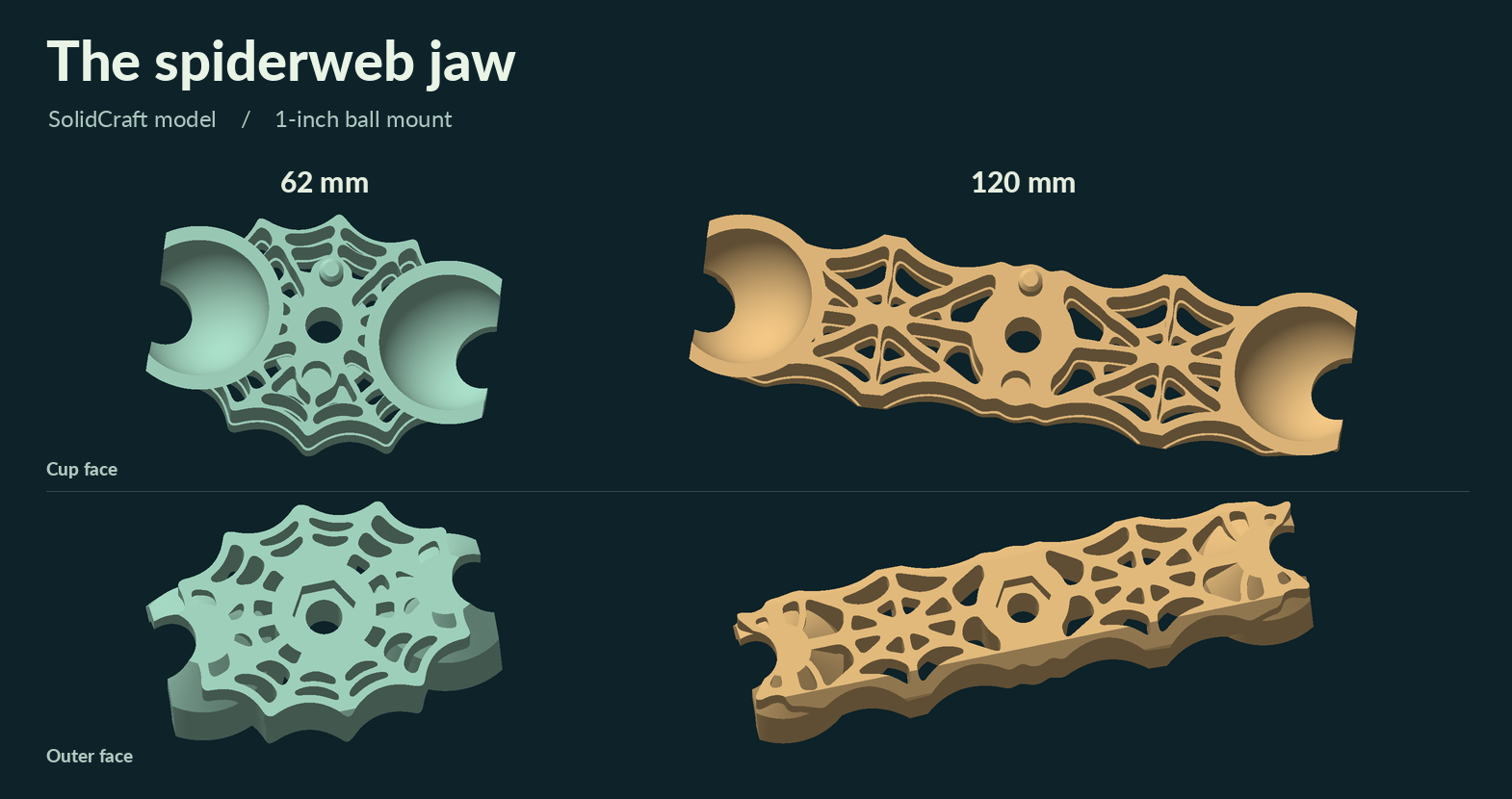
The deeper spokes run into the cups. Shallow scalloped ties connect adjacent spokes. These views come directly from the printable meshes.
We gave a beam optimizer spokes, hoops and diagonal braces to choose from. It sized the members across four load cases under a fixed material budget. Eight candidate members dropped out of each size. The printable model gives the retained strands width, rounds their junctions and preserves the bearing surfaces for both balls and the clamp hardware.
What the web costs
| Length | Original jaw | Smooth jaw | Spiderweb jaw | Spiderweb travel at 3 g |
|---|---|---|---|---|
| 62 mm | 15.77 g | 13.02 g | 14.85 g | 0.30 mm |
| 95 mm | 24.51 g | 21.39 g | 20.45 g | 0.84 mm |
| 120 mm | 31.11 g | 26.71 g | 23.53 g | 1.76 mm |
| 150 mm | 39.04 g | 33.17 g | 26.68 g | 3.51 mm |
Each mass comes from slicing one jaw. The 62 mm web saves 0.92 g per jaw against the original. The smooth version uses 1.83 g less than the web and gives 0.20 mm of predicted travel at the tablet, versus 0.30 mm for the web. The 150 mm web saves the most filament and also bends the most.
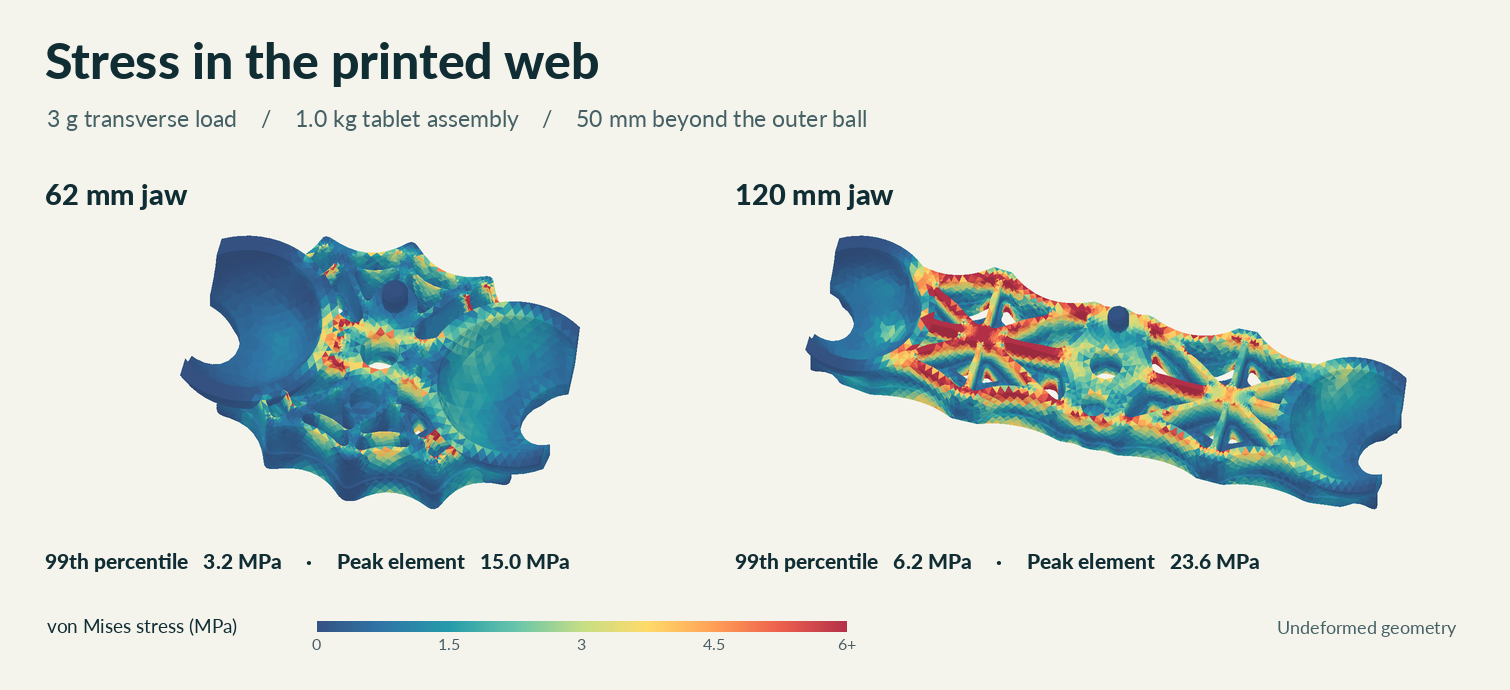
The service load applies 29.4 N to an assumed 1.0 kg tablet, case and adapter, shared equally between two jaws. The colors use the same von Mises stress scale in both images.
What the film models
In the virtual fixture, one jaw bends as the remote load point moves downward. A finite-element solve redistributes the load after each group of failed elements loses stiffness. Peach faces mark newly exposed fracture surfaces. At the end, the rendering offsets the gold fragment by 4 mm so the break is visible.
The virtual print has stiff perimeter material and a softer infill core. The tensile criterion uses 92 MPa in the print plane and 47 MPa across the layers. Those values come from dry, annealed, solid coupons. The model omits fracture energy, interlayer shear failure, plasticity, temperature changes and large rotations. The first bench test will tell us how closely a printed web follows this sequence. Bambu Lab PAHT-CF technical data sheet